

Showing posts with label sun. Show all posts
Showing posts with label sun. Show all posts
Saturday, February 8, 2014
The sun is crackling with sunspots right now


Friday, May 11, 2012
Sunspot 1476 - one of the biggest in years
Amateur radio operators from around the world are watching with interest
developments on the surface of the sun, where one of the largest
sunspots of recent years has broken out.
 Sunspot 1476 is capable of producting X-class solar flares, the strongest type possible. Amateur astronomers are easily able to glimpse the sunspot by projecting the image of the sun using binoculars or a telescope onto paper. Remember to never look directly at the sun through binoculars or a telescope as it will burn your retina(s) and you will be permanently blinded. Always project the image.
It was this method that I used this morning while showing my two daughters this massive sunspot. We set up my Steiner 20x80 binoculars on a tripod and projected the sun's image into a piece of white card, held about a foot from the binoculars.
You can see Sunspot 1476 in the first image, just below the rough centre of the sun's disk. There are also two smaller sunspots to the upper left of the image.
 The second image demonstrates how simple it is to see sunspots without harming your sight. By moving the binoculars around you will see where the shadow becomes most slender and if you hold the paper close to the eyepieces you should see two small bright dots. By pulling the paper back from the binoculars the sun's image becomes much larger. Of course, the image must be focused properly using the focusing mechanism on the binoculars. Remember the safety warning though! If you remember as a child using a magnifying glass to burn paper or grass, and if you think that binoculars are more powerful than a magnifying glass, you can just imagine what might happen your eyes if you were to use binoculars to look at the sun. In fact, it is not even safe to stare directly at the sun with your eyes. Always use something to project the sun's image.
Anyway, the reason all this is relevant to amateur radio is because radiation from the sun interacting with layers of the earth's upper atmosphere (called the ionosphere) causes, or aids, the propagation of shortwave radio signals. The solar flux is currently 131 sfu which is a good figure, and if it rises above this we might see good propagation on the higher bands, particularly 12 metres and 10 metres. Of course, if there are X flares we could well see aurora borealis too, and this has the effect of dampening HF propagation while boosting VHF propagation.
An image of sunspot 1476 from the Space Weather website is shown on left. We shall keep a close eye on its progress!
 Sunspot 1476 is capable of producting X-class solar flares, the strongest type possible. Amateur astronomers are easily able to glimpse the sunspot by projecting the image of the sun using binoculars or a telescope onto paper. Remember to never look directly at the sun through binoculars or a telescope as it will burn your retina(s) and you will be permanently blinded. Always project the image.
It was this method that I used this morning while showing my two daughters this massive sunspot. We set up my Steiner 20x80 binoculars on a tripod and projected the sun's image into a piece of white card, held about a foot from the binoculars.
You can see Sunspot 1476 in the first image, just below the rough centre of the sun's disk. There are also two smaller sunspots to the upper left of the image.

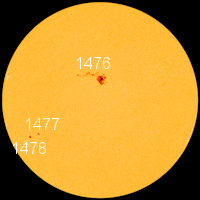 |
| An image of sunspot 1476 |
An image of sunspot 1476 from the Space Weather website is shown on left. We shall keep a close eye on its progress!
Subscribe to:
Posts (Atom)