Thursday, August 5, 2010

An interesting week on the DX front

It's been an interesting few days on the DX front. Just when the bands seem dead and propagation seems awful, up pops some decent DX. For instance, take Sunday night as an example. Having not been greatly active on HF for a number of weeks (although making a couple of QSOs a day just to keep my hand in it!) I decided to put out a "CQ DX" on 40 metres CW on Sunday night. Within a short time I had the United States and Canada coming back to my call. -.-. --.- -.. -..- -.-. --.- -.. -..- -.. . . .. ..--- -.- -.-.

About 20 minutes into my session, I heard "dit dit dit dah, dah dit dah". That's VK to all you non-CWers out there! Now most hams and SWLs will know VK is the prefix for Australia. I assumed that what I was hearing was a suffix, so I gave "dit dit dit dah, dah dit dah, dit dit dah dah dit dit" which translates as "VK?" - in other words, the station containing VK give your call.

He came back with "VK6BN". I couldn't believe it - my first Australia on 40 metres! The operator's name was Alan and we exchanged reports and names before giving the 73. (That's Alan in the photo). I was delighted. Especially because I am working just 100 watts into a 55-metre random longwire (arranged in a W-shaped configuration because of my short garden). So it just goes to show what's possible on a limited setup.

On Monday I could see from DX Scape that 10 metres was open to South America, something that hadn't happened for a while. There was a station from Chile on SSB - CE2WZ, David in La Serena. I could hear him although he was very QSB. As I very often do in these situations, especially when he is working a bit of a pile-up and the European zoo is shouting, I sat with the headphones on and listened for a while as I did other things on my computer. After about ten minutes I noticed he suddenly became louder and, sure enough, he was coming up and down from about 4 and 1 to about 5 and 7 with heavy QSB. So I gave him a holler. After being beaten to it by four or five European stations David eventually heard me. He gave me a report of 5 and 1 which was respectable given my 100 watts and a multi-band vertical.

Yesterday I received an AG eQSL from David confirming the contact so I was delighted with that. Thanks again David and best DX.

Last night (Wednesday) things were quiet on 80m, 40m, 30m and 20m. I had to content myself with some European contacts. I could hear Argentina and Paraguay on 20m SSB and 40m SSB respectively but they could not hear me. Ah well, you can't win them all!!

73 for now and enjoy the DX!
EI2KC

Wednesday, August 4, 2010

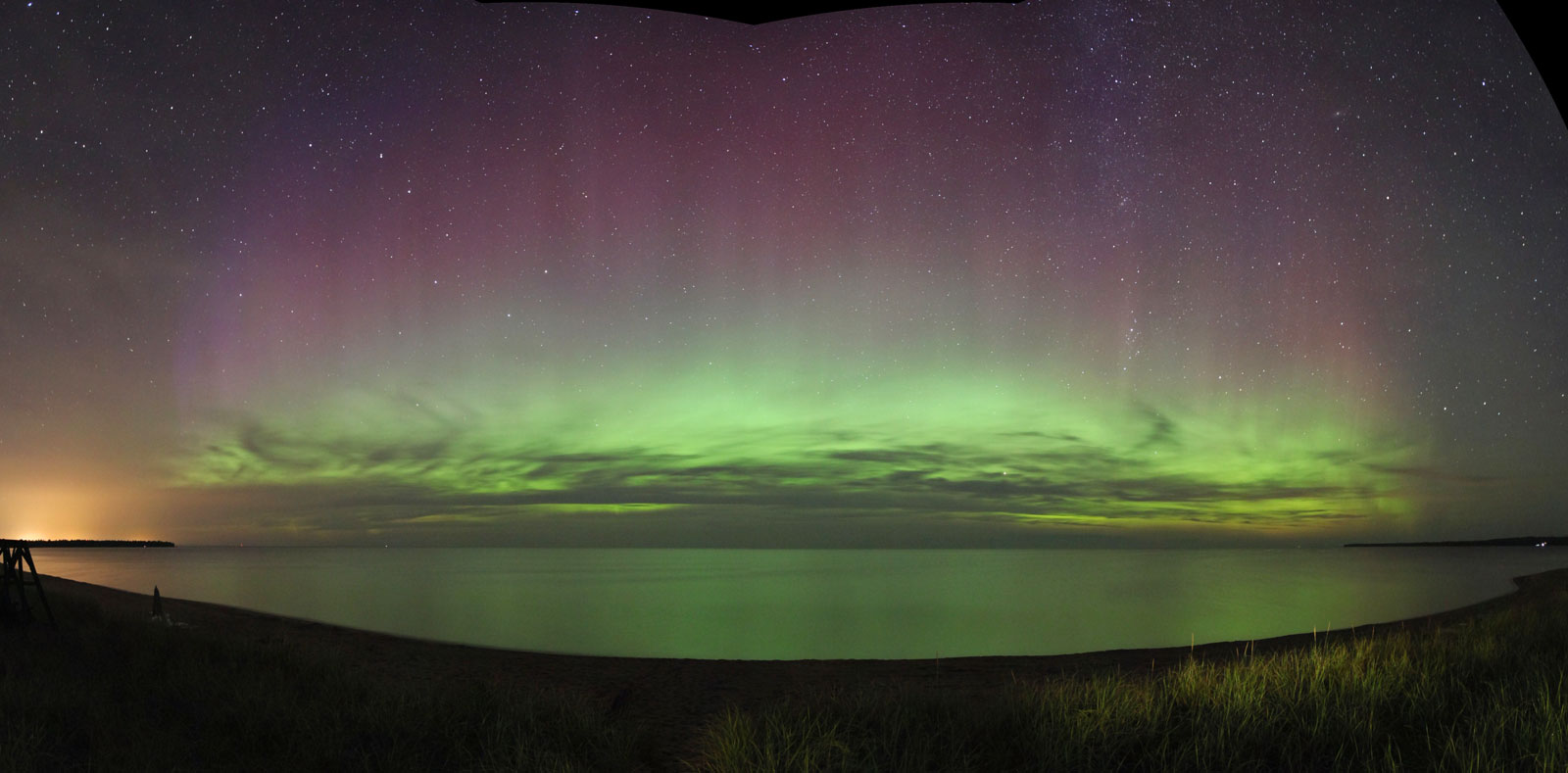
Aurora alert - Northern hemisphere sees northern lights

Amateur radio enthusiasts are advised to keep a listening ear on the VHF bands as the earth is hit by geomagnetic radiation from the sun. Aurora Borealis (Northern Lights) were seen last night as far south as Germany and there are warnings of possible further waves of geomagnetic storms in the coming hours.

Spaceweather.com says the following:

The solar storm of August 1st sent two CMEs toward Earth. The first one arrived yesterday, August 3rd, sparking mild but beautiful Northern Lights over Europe and North America. The second CME is still en route. NOAA forecasters estimate a 35% chance of major geomagnetic storms when the cloud arrives on August 4th or 5th. High-latitude sky watchers should remain alert for auroras.

We have no reports yet as to whether any Irish amateurs experienced any lift on VHF as a result of auroral activity but a coronal mass ejection (CME) hit Earth's magnetic field on August 3rd (yesterday, Tuesday) at 1740 UT. The impact sparked a G2-class geomagnetic storm that lasted nearly 12 hours - time enough for auroras to spread all the way from Europe to North America.

Keep an eye on things at www.spaceweather.com and the NOAA POES site.

Sunday, August 1, 2010

Working France with my home brew CW paddle


I made two of these home-brew CW paddles a while back, about two months ago now. I use one on my main HF rig, the FT-1000MP, and the other is in the car. Both were fashioned from the same block of wood, a length of wire (cut into two lengths), two headphone jacks, some screws and picture brackets, and some hacksaw blades. I estimate that both cost about 12 euro to make (6 euro apiece!). They work a treat, as you can see in this video.

Thursday, July 29, 2010

The two A's - Australia and Aland Island - make it 71 AG eQSLs

My confirmed country total on eQSL has risen to 71 thanks to two new recent eQSLs. It turns out that my contact into Tasmania - my one and only IOTA contest QSO! - was in fact fortuitous in more ways than one. Not only was it a new country for me (if you consider Tasmania to be separate to Australia that is), but it was fortunate that VK7ZE is also on eQSL - and Authenticity Guaranteed as well !! So thanks Laurie for that.

The other new one was OH0/DK1MAX. Max from Germany was on the Aland Islands in the Baltic during July and the contact was made 6 metres CW. So again thanks Max for the nice one on 6. My country total on 6 metres now is 53 (that's 53 in the log, not 53 confirmed!) and I only started working 6 metres this season. So I'm very happy with that.

Monday, July 26, 2010

My one and only contact in the IOTA contest was a new one!!

For a variety of reasons I was unable to dedicate myself to the IOTA contest at the weekend. I did, however, get a chance to listen in on proceedings at around midnight on Saturday. The bands were not packed with contest activity as I might have expected but there was more activity than usual nonetheless.

While working on a video editing project I was listening to VK7ZE on 14.220. He was faint enough in QSB, coming up and down from 4/1 to 5/3. I listened for about half an hour as he worked the contest and he seemed to be getting into Europe quite well from Tasmania.

Then he seemed to hit a quiet patch. He called QRZ IOTA contest a couple of times and nobody went back to him. So I decided to key up and call him and what do you know, he comes straight back with my callsign, my serial number and his IOTA number. I have him 59 001 EU-115. And that was it - my first Tasmania!!

Thursday, July 22, 2010

Congrats to Michael on passing the test

I've just received a phone call from my friend Michael Nolan in Kilkenny who has passed his amateur radio test at last. Well done Michael.

He scored 63% in Section A, 73% in Section B and 60% in Section C, with a 60% mark required in each section to pass.

Michael is proof of the old mantra that - "if at first you don't succeed, try, try again". He sat and failed the test in June 2009 and again in October 2009. But he was determined to get there and was one of just nine candidates to sit the test a couple of weeks ago in the Comreg offices in Dublin.

Well done again Michael. I look forward to hearing what your new callsign is (I'm guessing it will be EI9G something B, possibly EI9GAB or EI9GBB or EI9GCB) and also I'm very much looking forward to working you on 80 metres!

Have a drink on me!

Thursday, July 1, 2010

Can we generate more EI activity?

This article appeared in the latest issue of Echo Ireland and is reproduced here to help generate some interest in improving activity levels, particularly on VHF and UHF:

At the most recent IRTS Committee meeting, members resolved to try and get more activity going, particularly in relation to the Worked All Ireland Award Scheme.

A comprehensive article on WAI has been written by Steve EI5DD but pressure on space prevents its inclusion in this issue. It will appear in the next issue.

Co-incidentally, Letters on the subject were received from Brendan EI7CS and via Brendan EI0CZ from Bill NF9A.

Brendan’s letter is printed below and is self explanatory.

Bill’s letter is looking for help in working all 32 counties in EI/GI, mainly on 20 metres.

In Steve’s upcoming article he suggests a frequency on each band.

The WAI ones are well established on 80 and 40 and 2 metres but we need to establish the ones on other bands.

Suggestions are sought for 2m SSB, 70cms, 6 and 4 metres.

Can we agree a time for all bands as suggested by Brendan?

I suggest you communicate with Trevor EI2GLB our VHF Manager on these issues.

In the meantime why not give a call on the WAI frequencies whenever you can.

Suggested Net Frequencies

80 Metres 3.680 MHz
40 Metres 7.068 MHz,
20 Metres 14.265 MHz
15 Metres 21.317 MHz
10 Metres 28.655 MHz
2 Metres 145.350 MHz (FM)